The Slovenian couple we met in Banaue had originally planned to go directly to Batad, a neighboring Ifugao village with an amphitheater of terraces. However, once they discovered that the public jeepney to Batad left late in the afternoon and a chartered jeepney costs 2,500 pesos (or about $60), they decided to hike the Banaue Rice Terraces with us (so as to not waste the day).
After discussing the options for Sunday over beers that night, we agreed to charter the jeepney as a group the next day to halve the cost. From there Lolita would take us on a tour around Batad (for an additional 1,000 pesos). The Slovenian couple would stay the night in Batad, while we’d take the jeepney back to Banaue to catch the overnight bus to Manila. Overhearing our chatter, a solo traveler from Holland asked if she might join our merry jeepney band. But of course. So now we were five.
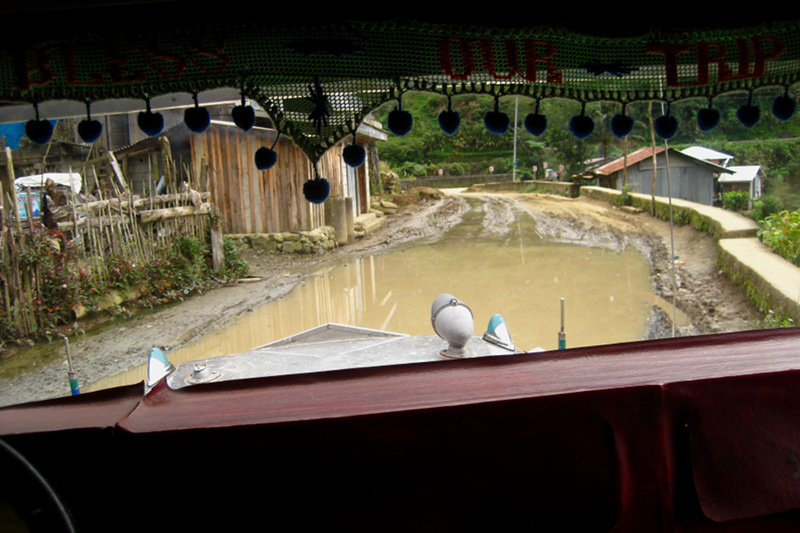
A trike seen through the back of our jeepney in Banaue
The next morning we piled into our very own jeepney for the trip to Batad. Getting there was an adventure in and of itself. The first hour was a curvy mountain road, most of it unpaved, interspersed with occasional sections of concrete. There was evidence of frequent landslides along the way as well as poignant scenes of rural life and surreal views of rice terraces.
We returned to Ubud for the final three days of our three and a half weeks in Bali, to do a little shopping and generally take it easy. Then on Wednesday the 5th we caught a flight to Jakarta, briefly gaining an hour, then giving it back, as we continued onto the Philippines—our first destination in the northern hemisphere since crossing the equator in September.
We arrived in Manila at 6am after a 4 hour flight and little sleep. We had a hotel booked for the first night, and figured we’d make things up after that. For the next 36 hours, we pretty much camped out there: sleeping, showering, and laundering to start, followed closely by vegging out on the internet. We made occasional incursions to the nearby mall for food and supplies, which gave us a taste of the frenetic, jeepney-powered energy of Manila. But generally we laid low to refuel for what was ahead.
A typical decorated jeepney, this one parked in Banaue
On Friday night we checked out, hailed a taxi, and tried to find a bus to take us up to the Banaue Rice Terraces (pronounced: ba-NA-way), a UNESCO World Heritage Site. Of course we never found the bus terminal we were looking for (Autobus) so we went with another in the area that looked good (Florida) and bought a ticket for the 9:10pm bus (only 400 pesos/person, or about $9). Our bus showed up late, so we didn’t hit the road until after 9:50. For the next eight and a half hours (yes, this was an overnight bus!) we were assaulted by blasting air-conditioning and the vocal stylings of Kenny Rogers. Actually it wasn’t Kenny Rogers the whole way, but there was music always playing. We were told later this was to keep the bus driver awake. Reassuring.
We had been tipped off about the A/C, so we brought layers (thank god) and had earplugs for the road noise (and Kenny), but still, it was comically awful. I must have managed to doze off, given my surprise to see light outside when I was jostled awake at 6:30 on Saturday morning in Banaue. We groggily got off the bus, reclaimed our packs, and tried to figure out what to do as various people, startling with their blood-red, betelnut-stained lips, asked us if we needed rides or guides or rooms. We were offered a free jeepney ride into town, saw some familiar foreign faces (from the bus) inside, so we hopped on, and they brought us down to a restaurant and guest house.
Looking across the town of Banaue towards the terraces
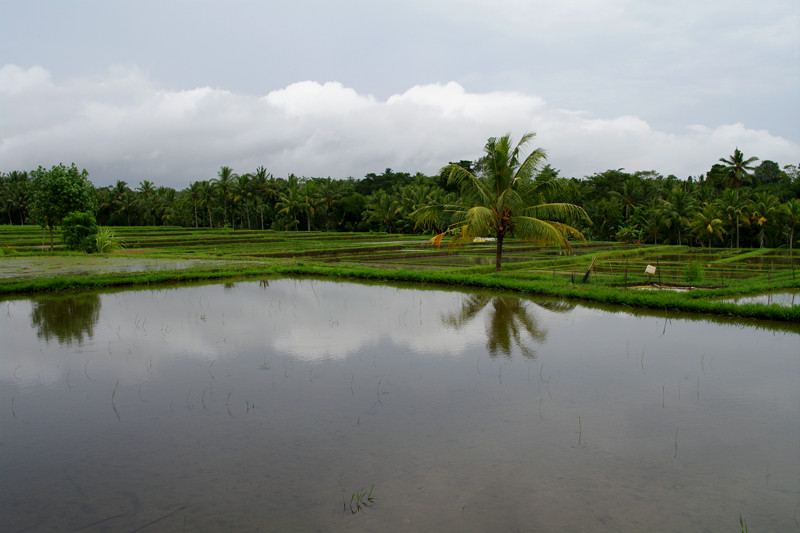
A few days ago Stephanie and I took a walk through the rice paddies north of Ubud. I found the unplanted (or already harvested) ones particularly photogenic, as you can easily see the borders demarcating each individual paddy (or terrace). The intricate waterways responsible for keeping them all submerged were mesmerizing. The ducks in the last photo are a form of pest-control (eating the bugs), a producer of fertilizer (pooping in the paddies), and a source of food (bebek goreng or “fried duck”).
After a short break in Nelson and later Blenheim, we found ourselves another wwoofing gig (previously we spent a week milking goats) at an estate vineyard and winery in the Marlborough region, well-known for its Sauvignon Blanc. The vineyard is composed of 3 separate tracts of land, totaling 163 hectares, producing around 25-30 thousand cases of wine a year (a case is twelve 750ml bottles). They also have olive trees on the estate for olive oil (did you know the oil comes from the pit and not the flesh? me neither…), some livestock (3 cows, 2 horses, sheep, and a dozen chickens), and vegetable gardens.
A week ago Friday (Nov 26) the estate manager picked us up at our backpacker in Blenheim and brought us to the house on one of their properties where we’d be staying. One of the full time employees lives there and looks after the wwoofers, which included one other person during our first week, an 18 year old from Canada. Afterwards he took us on a tour of the vineyard where we’d be working.
What are our days like? Every morning we set the alarm for 6:15 in order to have time to make breakfast and tea and get lunch together for the day. We leave the house around 7:10 on bikes they’ve provided, cycling 5km up the road to the main vineyard property. We find out what we’re going to be doing and usually start around 7:30. Most activities are done in groups, so we’re rarely alone—usually chatting with the people who work there full time. At 10:00 we break for morning tea—which amounts to a “second breakfast” given the substantial amount of food consumed for the day ahead. We resume working until 1:00 when everyone breaks for lunch—usually leftovers supplemented by eggs and olive oil from the vineyard. Then we take off after lunch and ride the bikes back to the house, to shower, relax, and eventually prepare for dinner, which we cook ourselves with food supplied by the hosts.
The primary vineyard activity we’ve been involved in is “shoot thinning”. Essentially we’re pruning the just-beginning-to-flower vines to concentrate the flavors and sugars in fewer bunches of future grapes. The more you thin, the better the grapes, the more expensive the wine. Of course very few people buy expensive wine, and cheaper bottles of wine sell in greater volumes with higher margins, so there’s a balancing act when pruning between maximizing quality and maximizing revenue. At least that was my understanding as we were taught to thin each bay (the area in a row of vines between two wood posts, about 7-8 meters apart, containing 3-4 vines) from 200 shoots to 100. Based on how much a bay had been thinned, and the variety of the grape, they could tell you how much a bottle of wine would be priced. In fact they’d often refer to certain rows as $25 Sauvignon Blanc or $45 Pinot Noir.
The other vineyard activity we’ve been involved in is “wire lifting”. The grape vines are grown on a trellise system known as “vertical shoot positioning” or VSP in which the vine grows vertically (like a tree) about 80cm off the ground, and then splits in two, running along a wire fixed to the posts about 80cm in each direction. Up from these horizontal “branches” (called cordons in French) the fruiting canes (or “spurs”) are spaced out every 20cm or so, and each branches out into six or more vertical shoots. Without any assistance, the shoots would grow in every direction and eventually be weighed down by the fruit. So once the shoots have been thinned, we walk along the entire length of each row (200-300 meters) and lift two sets of movable wires up to variously spaced clips on both sides of each post, in effect sandwiching the vines vertically.
Idyllic view from our bedroomTaking a break from shoveling compostNice view between the vines on a hillStephanie shoot thinningJustin shoot thinningHow a row looks after shoot thinningHow a post looks after wire lifting
One of the interesting coincidences of this trip so far has been meeting up with the passengers who stayed in our cabin on the Cap Cleveland (between New Zealand and Philadelphia) before we got on. We never met in Philadelphia—they got off the ship in the morning, and we boarded in the afternoon, but Jeoffrey (the third officer) recalled various stories involving the Mullins along the way.
That would have been the end of the story, had it not been for their Canadian friend who was coming to visit them in New Zealand. He googled for the Cap Cleveland, found my blog, and passed the URL along to them. They left a comment on my Tramping Rangitoto post while we were on the North Island heading south. There was a slight chance we could have crossed paths after the ferry to the South Island, but we didn’t connect with them over email until we were well south of Christchurch.
That would have been the end of the story, had I not been flipping through our Tramping New Zealand book wondering if there were any Great Walks we could do given our failed attempt at the Tongariro Alpine Crossing. Key attributes being: accessible by public transport, not too strenuous, and high probability of good weather. All signs pointed to the Abel Tasman Coast Track—and in the back of my head I was thinking, who knows maybe we could meet up with the Mullins, who lived nearby. It was also an area we hadn’t visited on our campervan tour of the South Island, and it gave us a geographical region to focus our wwoofing search.
To make a long story short, we did finally meet up, and spent a lovely afternoon together waxing nostalgic about our time at sea. Since then we’ve seen Peter and Lorraine on several occasions, and they’ve been exceptionally kind in showing us around, whether it be to the start of the Abel Tasman Coast Track, to the World of WearableArt and Classic Car Museum, or to Blenheim, where were traveled with them last Tuesday, stopping at Nelson Lakes National Park on the way.
Peter, Stephanie, Loraine, and Justin—just before we started on the Abel Tasman Coast TrackView of Lake Rotoiti in Nelson Lakes National ParkSwarm of eels under the dock in Lake Rotoiti