After experiencing firsthand the plight of “domesticated” Thai elephants at Elephant Nature Park in Chiang Mai, it was nice to come face-to-face with several herds of wild African elephants at Maasai Mara. On our second day, we stumbled across a large group of fifteen elephants walking across some dry grasses (from which most of the photos below came).
On our third day we discovered a group of elephants munching on the leaves of some dense small bushes, when another group showed up, nearly stampeding, and exhibited a terrific display of stomping, head shaking, ear-flapping, and spine-tingling roaring. (I’m not sure if it’s true, but I’ve heard that the dinosaur roars from Jurassic Park were recorded from elephants.)
It was hard to tell exactly what was going on (or take any meaningful photos), but there must have been over 30 elephants clumped among the bushes, staring each other down. Perhaps the second group was defending their luscious green territory? At one point the retreating group of elephants started inching towards our 4×4 so we got out of their way quickly.
One elephant walking through the grassA baby elephant surrounded by its familyThe herd walks away
Though leopards are one of the more elusive animals to spot in the wild, we were lucky to see one twice on our Maasai Mara safari. Not only are they shy and solitary creatures, but they also spend a lot of time in trees, which makes them doubly hard to find. On our second day, we observed one sleeping on a branch. It was great for the eyes (with binoculars) but difficult to get a good photo of.
On our third day, we went back to the same spot, because a leopard had been spotted on another tree nearby (though I didn’t know that at the time). As we were bouncing down the dirt track on the way there, I snapped a few shots out the roof of another ubiquitous Maasai Mara creature: humans, most in the form of “matatus” gathered around wildlife. What I didn’t realize until later was that I’d captured a one-in-a-million shot of the leopard in the tree, just as he was climbing down. By the time we got there, he was walking through the grass to the tree where we’d caught him sleeping the day before. When we drove over to the first tree, we got another surprise.
Lucky shot: matatus (minivans) around a tree with a leopard in itThe leopard paces through the grassThe leopard turns to look behind him
Giraffes are easily one of my favorite animals from our Maasai Mara safari. So cool, breezy, unaffected. They tower above everything else, including the foliage, making them easy to spot in the distance.
The experience of seeing a giraffe in the wild is surreal, like a childhood picturebook coming alive. It’s funny to realize that so many of the “exotic” animals we learn about in school all come from East Africa (with the exception of the tiger).
Sometimes they’d gather in small groups, often among many different animals, other times we’d see a whole herd walking or eating together. They seem clumsy and indefensible, like a horse walking tenuously on silts, but apparently a well-placed kick from one of their hind-legs can break a lion’s neck. Take that!
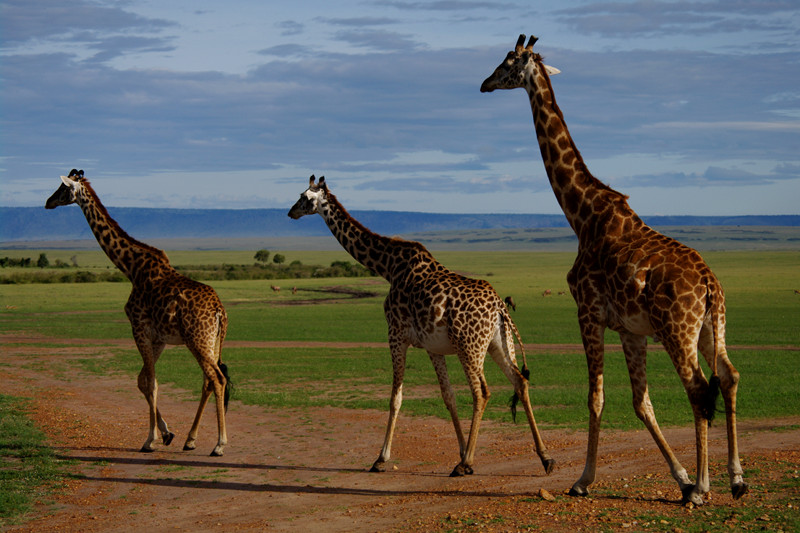
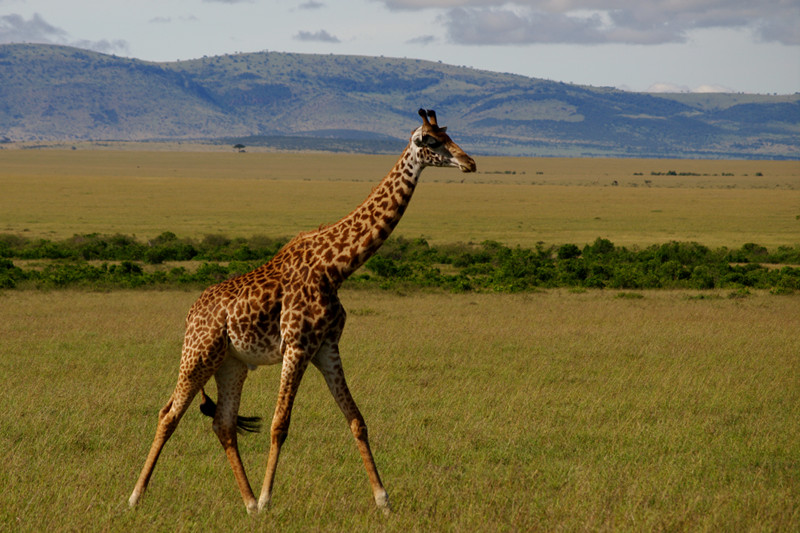
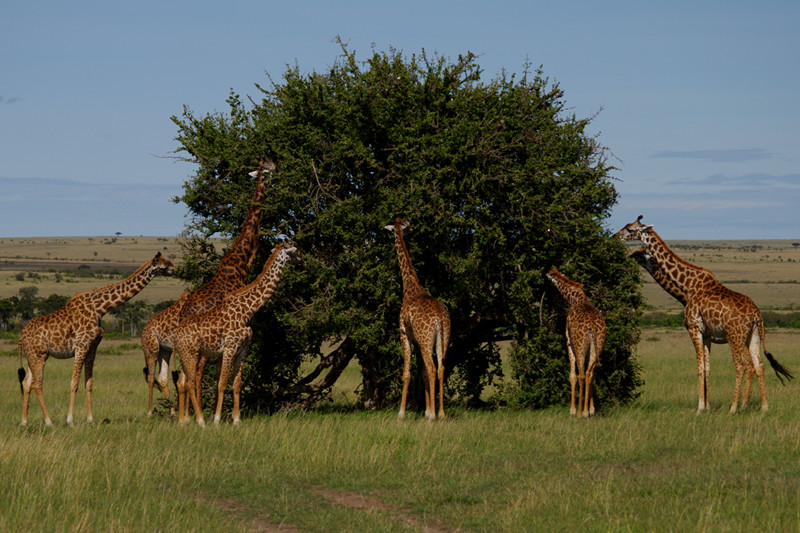
Three giraffes crossing a track in the early morningWalking in the grassGiraffes pruning a tree
I see a hot, dry savanna, deep in East Africa, several days from civilization. The grass is tall and yellow. The sporadic, solitary trees cling desperately to life. Transport is a 1970s-era white Land Rover, with various protective bars along the sides, a rack on top, and a spare gas can on the back. There are four passengers inside, maybe a fifth up front, and a driver, all of whom are wearing khaki “safari” shirts, bandanas, and broad-brimmed hats. Large binoculars poke out of partially rolled down windows in the direction of lions a hundred meters away, barely visible in the tall grass. In my mind the only animals are lions and elephants, the latter appearing almost jet black against the white sky. The driver carries a rifle in case any wildlife gets too close.
Well, that was what I had imagined. This is what happened.
On May 5th we flew from Mumbai to Nairobi, Kenya, arriving early in the morning. We spent 4 days relaxing and recovering at Wildebeest Camp, a veritable oasis within the city, part hostel, part budget hotel, part safari-chic B&B. Stephanie and I opted for the latter, staying in a “garden tent”, a spacious “safari-style” fixed tent with a queen-sized bed, two nightstands and a low table for our bags. Bathrooms are shared in a convenient outdoor area. Breakfast is included, and a number of homemade lunch and dinner options are available. It was wonderful.
Waving to our Moms on Mother’s Day outside our garden tent
The reason we’re currently in Nairobi (besides a strong desire to visit Africa) is that it’s the starting point for our 19 day overland expedition into Uganda (and maybe Rwanda) where we hope to see some mountain gorillas. Along the way we’ll stop at various national parks and natural wonders. We’ve heard there will be about 16 people on the trip, plus a guide and driver. Though we’d initially entertained the idea of doing a longer Nairobi to Cape Town expedition, in the end we figured 3 weeks was a safer length of time to spend with a truckload of strangers after 9 months of independent travel. Plus we were especially interested in the concentration of natural features covered by the 19 day trip, aptly named “Gorillas and Gameparks”.
In addition to the overland trip (which departs today!), we were able to “add on” an optional 4 day safari at Maasai Mara National Reserve in Kenya, about 6 hours southwest of Nairobi. When we booked it, we had no idea what we were getting ourselves into. We didn’t know what or where “Maasai Mara” was (such that we started calling it Masa Maarai—an incredibly hard habit to break!) nor what a safari entailed, beyond my quaint imaginings above. I did know I’d probably want to take photos of animals at a distance, which is the reason I picked up that new 50x200mm zoom lens back in March (though Stephanie creatively proves that all one really needs is a point & shoot camera and a pair of binoculars).
The safari was operated by a local Nairobi company called Gametrackers, so last Monday, Stephanie and I and Naas (a South African man returning to Cape Town via the Nairobi to Cape Town trip after living for 10 years in Ireland) checked out of Wildebeest, and took a taxi to their office downtown. There we met our driver/guide, Rufus, our cook, Gabriel, and our vehicle, a brown 1990s-era Toyota Land Cruiser.
Our Land Cruiser at lunch in Narok
It took over 6 hours to get to the Maasai Mara National Reserve, the latter part on crumbling asphalt and potholed dirt roads. On the way we crossed the escarpment overlooking the stunning Eastern Rift Valley (traveling on a road built by Italian POWs during WWII).
Of the 70 California State Parks that will be closing due to the budget crunch, I was surprised to discover that I’ve been to 10 of them. Annadel State Park in particular, an enormous and beautiful park east of Santa Rosa, was a site I visited regularly for hiking and mountain biking when I first moved to California.
But the closure that hits closest to home is Jack London State Historic Park. I only went there once, but it happens to be the location of the first hike I took with Stephanie, two weeks after we met at a Halloween party in 2005. Stephanie says “that one hike opened the door to all of our future hikes together.”