After Udaipur we went Mount Abu, one of the lesser known colonial-era hill stations. It’s now a weekend tourist destination for Indian families from nearby Gujarat, many of whom come to visit their children at the local boarding schools. It was a refreshing change of pace for us, as we were no longer the intended audience for touts, street merchants, and similar characters. Most of the people there, tourists themselves, looked upon us with amusement.
We spent four nights at a family-run guesthouse and chilled, literally, in the slightly cooler mountain air. One night, a friend of the owner’s led us on a hike along the rocky meandering trails, up to the third highest peak, and then to a dramatic viewpoint overlooking the surrounding countryside at sunset.
The most chaotic part of our overnight train from Kolkata to Mughal Sarai was the taxi ride to Howrah Station at 8 at night. The shear volume and variety of traffic en route boggles the mind.
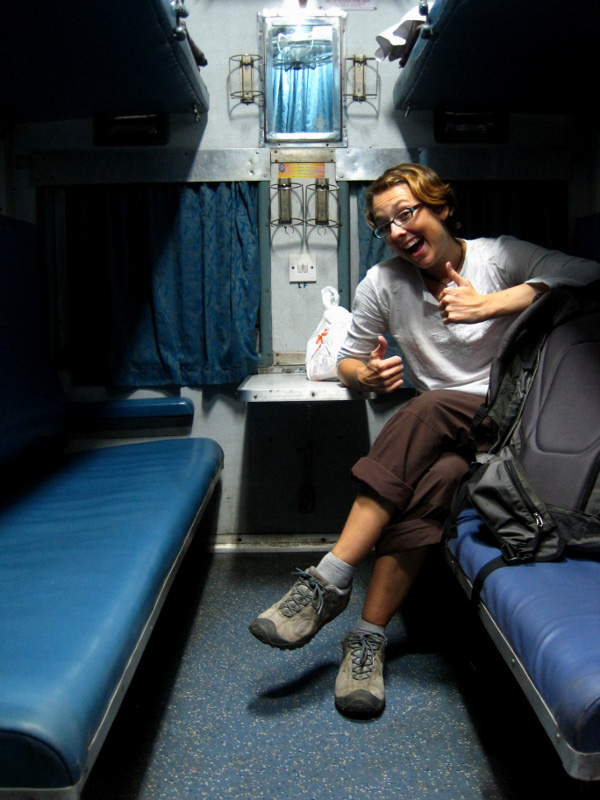
We had class 2AC tickets, basically 2nd class, air-conditioned—but it was effectively 1st class, as no 1AC trains depart from Kolkata. The train car was relatively wide and spacious. The AC was pleasantly copious. In addition, each compartment had a fan. Stephanie felt fine. Phew.
Stephanie gives the thumbs up
After a while there were six people sitting in our compartment with 4 beds: a newlywed couple with their mother, an older man who didn’t say a word, and the two of us. The couple, two doctors from Kolkata, started the usual interrogation, but added some more pointed questions about how much this months-long travel was costing us and what exactly was the benefit—how would it affect us professionally? I’m not sure our answers were satisfying—it’s been a long time since we had to justify what has seemed self-evident to everyone we meet—but we tried. As the train started to pull out of the station, the husband stopped whatever he was saying mid-sentence, bid us goodbye, and the couple rushed off the train. Now the sleeping arrangements made sense. Stephanie and I took the top bunks so the mother and the old man could sleep on the bottom.
I drifted in and out of sleep, waking ahead of my 7:30am alarm. We were due to arrive in Mughal Sarai at 8:10. The train would continue after that and I did not want to miss our stop. There was no conductor announcing stations nor checking to make sure we got off at the right place.
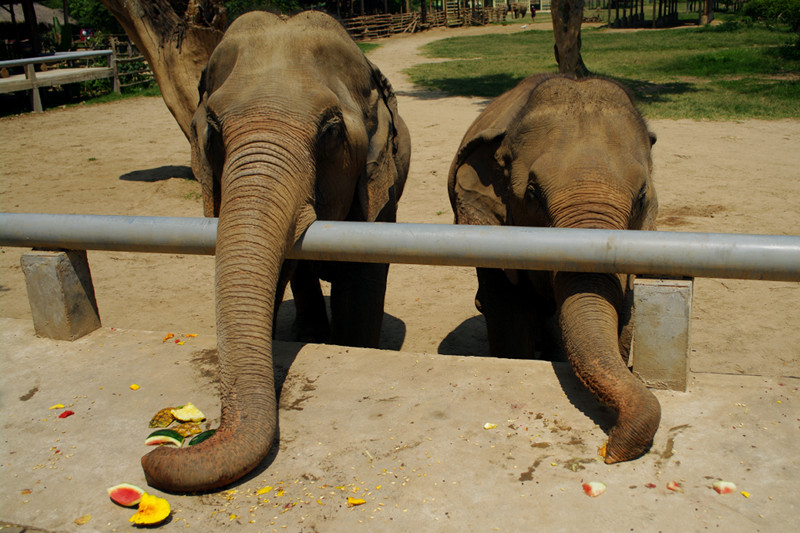
I wanted to post a few more photos from Elephant Nature Park as a follow up to my previous post, My elephant week. But first, a little photography navel-gazing.
I picked up a new 50-200mm telephoto zoom lens (for an upcoming leg of our travels) which arrived in Chiang Mai just before I started volunteering (thanks to the parents). So I had a chance to “kick the tires” a little at the park—specifically the photos I took of the elephants bathing in the river (or on their way there). All the other photos (and all the photos I’ve taken on the trip thus far) have been with Pentax’s 21mm F3.2 “pancake” lens.
One thing I learned in the process is just how hard wildlife photography is, especially knowing that these elephants are not that wild. Just because I have a telephoto zoom does not mean I instantly take awesome photos of animals. If anything, it’s harder, because my position in the immediate vicinity affects the final picture less, so I’m more dependent on the unpredictable behavior of the animal (“Umm, excuse me Mr. Elephant, could you please go back and hold that pose a little longer?”)
The experience did teach me a lot about the type of photos I enjoy taking: ones that capture the whole scene and ones where you feel immersed in the scene, both of which favor wider angles. With the elephants, I was surprised how often I had to “step back” with my 21mm (32mm-e) lens to capture the whole elephant, or otherwise get the composition I wanted. The wide angle, prime lens makes photography feel like an active, engaging sport. The telephoto zoom lens made me feel like a static, passive observer. At least on my first outing.
And now for something a little more elephantine:
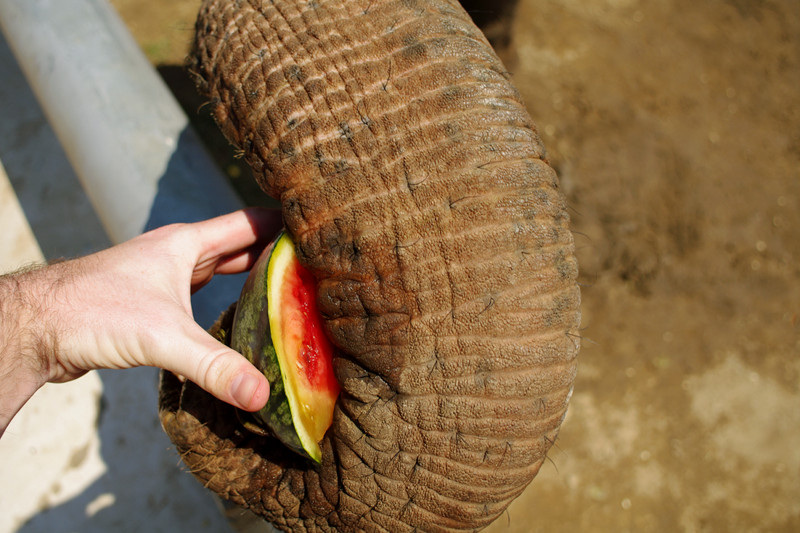
Taking a break between bitesMunchin’ on bananas (one of my favorite shots)
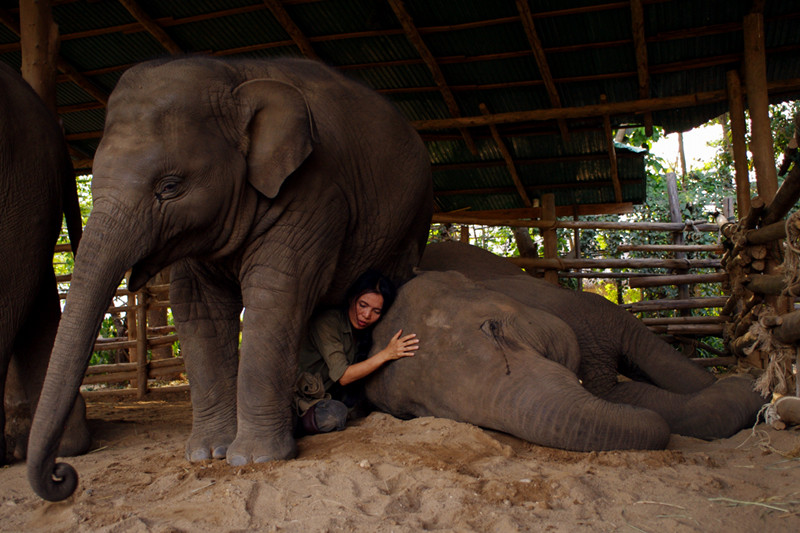
While Stephanie went down to Koh Phangan for a 10 day yoga retreat, I stayed behind in Chiang Mai to volunteer at Elephant Nature Park for a week. The park, founded in the early 1990s by Sangduen “Lek” Chailert, is a sanctuary for domestic Asian elephants that have been rescued from logging and trekking operations, street begging, and performing. Many of the elephants have serious physical and mental handicaps, due to mistreatment, malnourishment, and/or the hardship of the labor they endured.
Lek singing an elephant to sleep (it was standing seconds earlier)
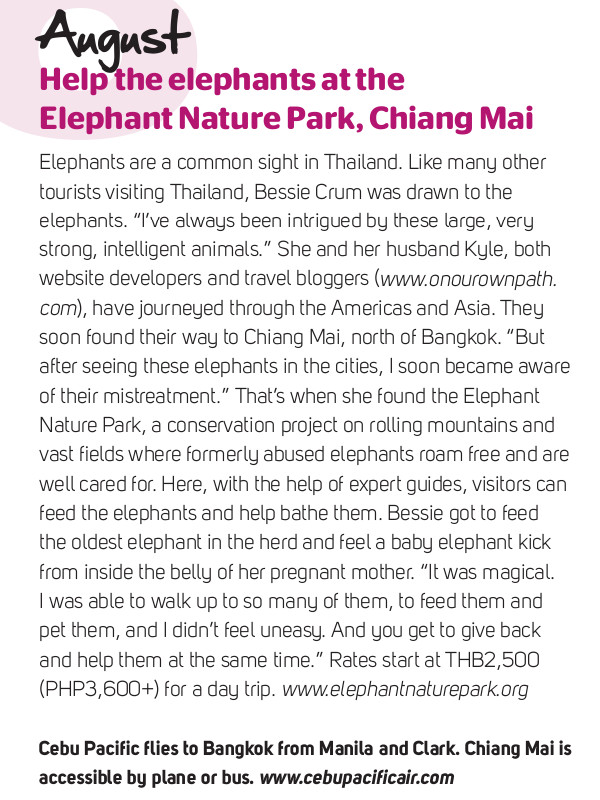
I learned about the park when while traveling in the Philippines, thanks to Cebu Pacific’s in-flight magazine, Smile. Their January issue had a feature on 12 must-do adventures for 2011. One of them was written by bloggers Kyle and Bessie of On Our Own Path (who I later discovered also knew Jodi, my Chiang Mai connection). I read reviews elsewhere about the park, and found people’s reactions to be overwhelmingly positive. It was uncanny. Usually someone comes away from a tourist activity with a “meh”, but almost everyone counted the visit as a highlight of their trip to Thailand—if not their lives. My curiosity was piqued.
I expected to be one of maybe 3-5 volunteers. The online application is surprisingly thorough (educational and employment history, essays on why you want to volunteer, general interests, etc.) and it actually costs money: 12,000 baht/week (~$400 USD)—a little steep for your average Southeast Asia backpacker (though to be fair, they house and feed you, and much of the money goes to the elephants). As it turns out, there were more than 30 volunteers starting with me, many staying for two weeks.
The program was very well organized. From their office in Chiang Mai we were bused to the park an hour away, which included a viewing of a well-produced documentary about the plight of elephants in Thailand on the way. The first day was similar to what one might encounter on a day tour (which Stephanie squeezed in before she left for her yoga retreat), predominantly centered around feeding and bathing the elephants. Then we continued with various volunteer orientations, including a welcoming ceremony by the local village’s spiritual leader.
We were a little nervous after we learned—a few weeks before our cruise—that a junk boat sank in Hạ Long Bay (also spelled: Halong Bay) killing 12 people (11 of them foreign tourists). We’ve put a lot of things at risk by going on this adventure, our lives not consciously being one of them.
Water buffalo on the way to Hạ Long Bay
We reassured ourselves that the high cost of our tour ($250/per person for three days and two nights on the bay) compared to the cut-rate boat that sank, was an indicator of quality. We chose one of the smaller luxury junk boats that ply the bay, the Prince III, part of the Indochina Junk family, with only 4 double cabins. Cruising with us were two couples our age, one from Singapore and one from Australia, and an older, but no less energetic couple from England. Everyone got along swimmingly.
Our junk, the Prince IIICarrot garnish lesson: Justin’s plane vs. chef’s craneFloating houses flying Vietnam flags