Hey hardcore Justinsomnia readers! Yeah, you! The folks who’ve actually got http://justinsomnia.org/ in your bookmarks. The folks who still periodically check my homepage for updates instead of subscribing to the feed. (I remember those days!)
I’ve just added a new feature with you specifically in mind.
At the bottom of the homepage, there’s now a handy little “Continue reading…” box. In the box is a link pointing to the left that says “« Older Posts”. If you click it, you’ll move back in time, by 8 posts.
This is handy if you haven’t checked my blog in a while and want to see what I’ve been up to recently—more than the 8 posts that appear on the homepage. Of course as you move beyond the homepage, a “Newer Posts »” link will appear, so you can navigate forward in time. It’s fun, try it!
Here’s a screenshot:
Happy Holidays from the fine folks at Justinsomnia. AKA me.
Note: Even though I originally wrote this for WordPress v2.3, it continues to work for all versions of WordPress through v2.9.x.
Background
Who knew that when I migrated my Blogger blog to WordPress way back when, I’d still be supporting a hacked together Haloscan importer 3 years later!
Awhile back, I don’t remember if it was during WordPress 2.2 or 2.3, the folks at Google revamped Blogger, which meant the old Blogger importer no longer worked. So the heroic coders that do the heavy lifting for WordPress set out to write the-Blogger-importer-to-end-all-Blogger-importers, this time using Blogger’s feed-based “API”.
The problem for you classic Blogger folk with Haloscan comments is that the only way to link your Haloscan comments to their post is via Blogger’s postID. Which is apparently not accessible in the feed API. Grrr. Which meant my previous hack for associating the postID with the newly imported WordPress post no longer worked.
Last night, I finally went back to the drawing board and came up with a new solution. I’ve tested it successfully on two different blogs.
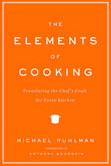
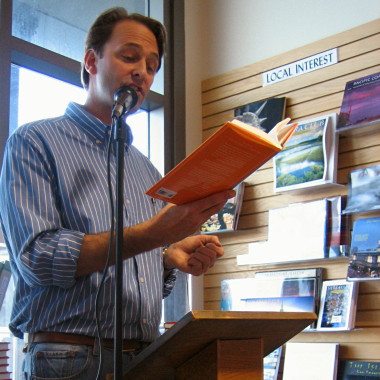
Last Sunday I got to see Michael Ruhlman read from his new book, The Elements of Cooking at the San Francisco Ferry Building.
Michael retold the story of what led him to that particular moment in time. An early love of the cooking and the kitchen, seeing Julia Child on TV, a botched attempt at an apple pie cum pear tart, persistence in getting into the CIA to write a book, meeting a restaurateur in Cleveland who connected him with Thomas Keller of the French Laundry who was looking to publish a cookbook…
He emphasized luck. He was lucky to write a book about the Culinary Institute at a time in this country’s history when Americans were developing a passionate interest in food and cooking. He was lucky to meet up with Thomas Keller at a time when he was merely a “guru among chefs” and not yet an internationally known celebrity chef.
He also emphasized speaking the language. Though he was a writer first, his culinary training and ability to speak the vernacular (and hand gestures) of a professional cook meant he was able to quickly earn their trust, and thus receive greater access for his books.
Michael seemed keenly aware of the impact and importance of blogs on writing and the publishing industry. He asked how many people heard about the reading through a blog (2/3 of the 30-40 people there raised their hands—I’d heard about it through his blog). He only recently started blogging at the insistence of Meg Hourihan, and had already come to accept it as an important part of his life, like a pet that needed care and feeding. A place to continue the conversation outside of his books.
Finally he read a passage from Elements on finesse. A survey of some of those almost unquantifiable and subjective tasks a chef will undertake to make a great dish sublime. I might say to make a great dish art.
I asked a question I’ve been meaning to speculate about on my blog—whether he considers his writing something akin to long-form blogging. Of course the obvious answer is no, given the entirely different demands of blogging and book writing. Namely his goal in writing a book is to create a cohesive narrative, to turn life into something that has an identifiable beginning, middle, and end. Whereas in his blogging he said he doesn’t worry about making sure every “i” is capitalized, let alone the rest.
I persisted though and suggested how reading a book is almost like engaging in this distant, unreachable world. Even if it’s nonfiction, the distance of that world from me, and the perfect encapsulating description of the characters make it indistinguishable from fiction. But when I started reading his blog, it took all these characters I remembered from his first two books books, real people he knew and still had contact with, and imbued them with new life. Updated them. It kind of punctured that artificial narrative ending and continued the story.
That and he really seems to have embraced his inner-chef as of late. He admits that his time at the Culinary Institute changed his life. Though he went on to write non-culinary books (experiences he managed to weave into his recent food writing), it seems like he’s starting to define his life around these culinary pursuits, with gigs at the Food Network, etc. He’s never just writing about someone from that “objective” journalistic perspective, he’s very much a character invested in his own stories, as much as we’re all characters in our own blogs.
My usual blogging style is notoriously sluggish. I’ll start with an idea, write a paragraph or two, futz with some photos if I’ve got any, surf the web and get distracted, search for a relevant link, lose my train of thought, reread what I’ve written over and over again, check my email and feedreader, find some food to eat, clip a hangnail that’s bothering me, check out Google News, reload Boing Boing…
Even a short post can suck up 2 or 3 hours like this. It’s ok, I figure, at least I’m not watching TV. But during our trip to Utah, I didn’t have that luxury, so I had to be as efficient as possible with only an hour or so of internet time per day (I know!).
I’ve also been wanting to post more photos than was practical with my paragraph-photo-paragraph-photo format, since some photos really deserve no more than a few words intro, if that. So I started structuring my posts with the bulk of the text at the top, and the images at the bottom. That way I could write the way I wanted to write, from start to finish, without forgetting any juicy details, and then afterwards I could mentally shift to my non-linguistic cortex and work on the photos, without having to break from the narrative or write redundantly descriptive, captain-obvious filler between photos.
Once the writing is down, I immediately go to work on the photos, in the order they were taken, maybe with one quick preview of the set ahead of time. At this point my Gimp Web Photo Editor extension is a crazy time-saver. In most cases, I just tweak the settings for the first photo and use those for each one that follows. After that it’s a quick ls -cr in the terminal to list the photos in order of last modified date, which I copy and paste into my blog post, wrapping each with <img src="/images/ and " alt="" /> and filling in the alt description.
Then I start the revision process, adding relevant links, correcting typos, improving flow, with minimal distraction. After I’ve read it through once or twice without making any changes, I hit Publish, and I’m done with it—ok, maybe I read it through once again on my blog. It’s always amusing how a slightly different context will expose errors and that I missed a dozen times before.
On Saturday, we invited some friends over for our first ever (maybe the first ever?) ravioli party. The new pasta machine was the inspiration, and the idea was simple. We’d provide the machine, the pasta dough, and more red wine than you can shake a stick at, and anyone who came would bring something they’ve dreamed about having stuffed inside ravioli.
We had no idea if people would take to the idea. We had no experience even making ravioli, having used the machine only once before. Amazingly as people showed up, they went right to the kitchen, chopping, sauteeing, preparing their respective fillings. How great, I thought, I can just sit back and sip wine all night. Ha!
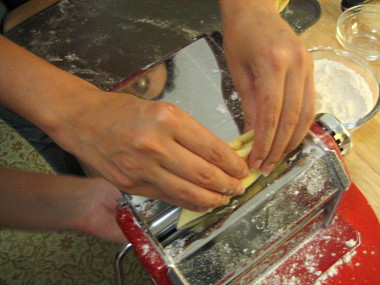
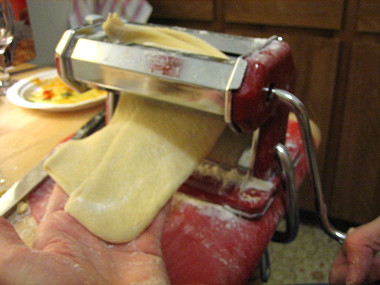
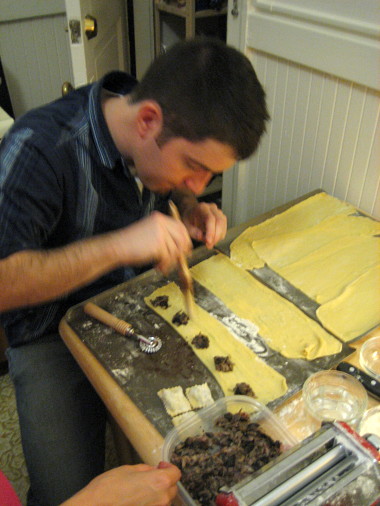
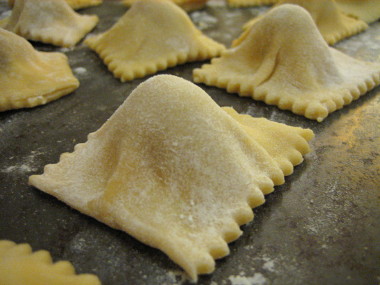
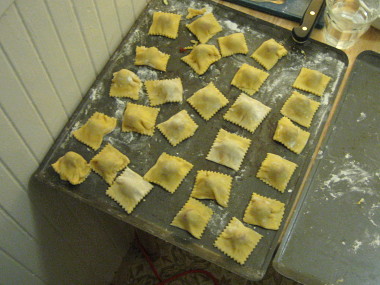
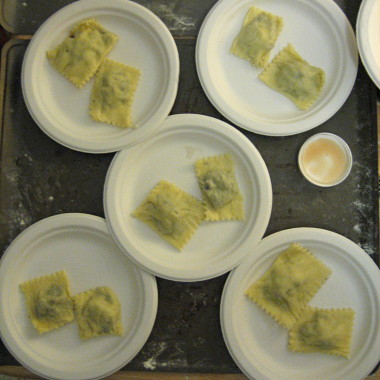
Actually I had a lot of fun. Once the fillings were ready and our core group had showed up, I began the ravioli production process (with lots of assistance). We’d knead and then flatten the dough through the pasta machine into sheets about 24 inches long and 4 wide. We’d cut that into two separate foot long sheets, placing the filling on half of the sheet in little teaspoon sized balls, and then folding the sheet lengthwise to seal and cut into individual raviolis. Each foot long sheet made about 5-6 raviolis, so we’d do about 4 sheets of each filling to make sure everyone got at least 2. After a quick boil, I’d sauce them with either homemade marinara or pesto. And repeat.
By the end of the night we’d made 6 courses of ravioli, with 4 batches of dough (16 eggs!), including a final improvised dessert course. Here was the menu:
Duck and portobello mushroom with plum sauce
Shrimp, pine nuts, and mushroom with marinara
White asparagus, caramelized onions, and truffled goat cheese with creamy pesto
Zucchini, prosciutto, dry ricotta, and basil with marinara
Sun-dried tomato pesto and aged cheese with marinara and pesto
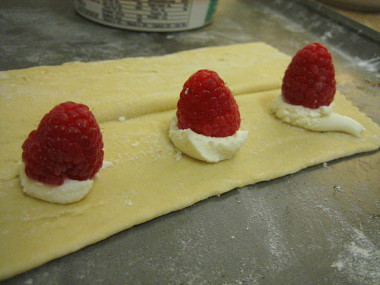
Raspberry and mascarpone with chocolate praliné sauce
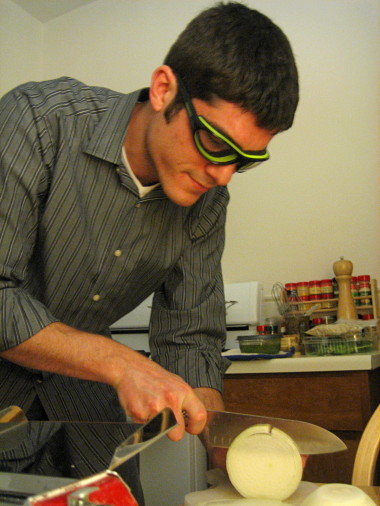
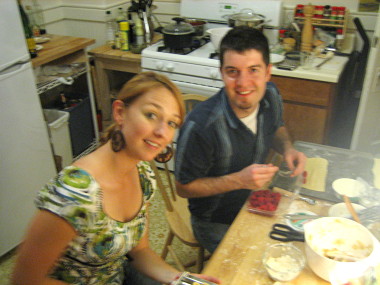
What can I say? It would have been spaghetti with marinara sauce without everyone’s creative fillings. Thank you all. Here are some pictures that I (and others) managed to take in between batches:
Danny testing out our onion gogglesStephanie and Justin at the ravioli prep table (a little image stabilization would have helped here)Feeding pasta dough into the machine (for kneading)Pasta dough coming out of the machineJustin making raviolisPreparing our dessert course of raspberry mascarpone raviolisRavioli porn closeupRaviolis anxiously awaiting their fateCooked raviolis excitedly awaiting their sauce