Stephanie’s paternal grandmother and other extended family members live in Pertuis, a small town north of Aix-en-Provence. We rented a car in Arles for a day and started on our way east. Thankfully Stephanie drove (she has a French driver’s license), and I assisted with navigation.
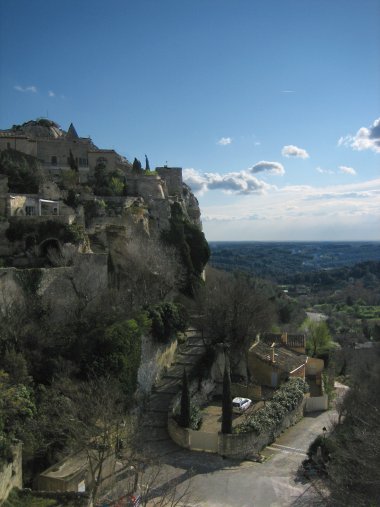
Along the way we stopped in Baux-en-Provence, a historic and scenic mountain-top village. Pretty cool, eh?
The Mistral winds were still blowing on Thursday (March 23 in blogtime). And we were starting to get a little tired of traveling, especially being at odds with the weather.
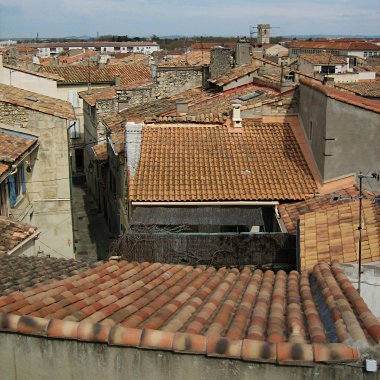
In spite of the wind, we wandered around Arles looking at Roman and Medieval ruins, old fortifications, aqueducts, stone walls, arenas, colorfully painted provencal doors and shutters, and a French cemetery that looked a lot like the cemeteries in New Orleans. Here’s a view overlooking Arles’ red clay roof tiles.
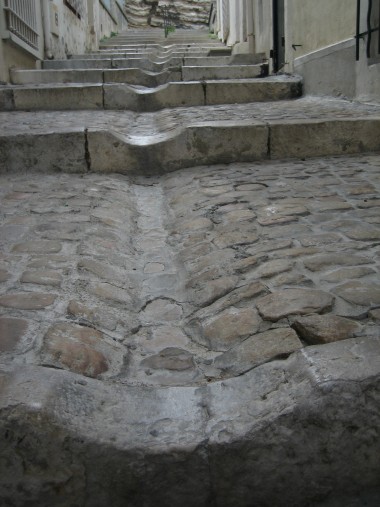
I particularly liked this drain built right into the steps.
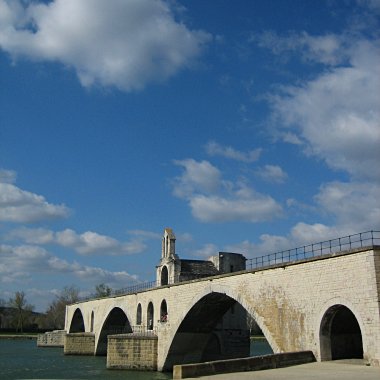
The other reason to visit Avignon other than the Palais des Papes (and the castle-like wall around the city and the charming shops, etc) is the Pont St-Bénezet—known more famously as the Pont d’Avignon.
You can think of it as the London Bridge of France. The title of the post are the first words of a famous French song traditionally sung at weddings. In English it translates to “on the bridge of Avignon, we all dance there, we all dance there.” We however, did not dance, we hung on for dear life.
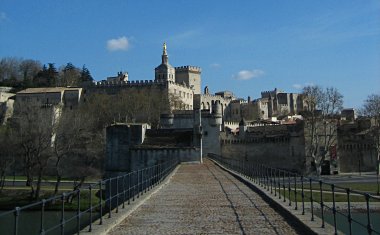
The saddest thing is that only 4 of the bridge’s 22 arches remain. You can see three over the Rhone in this photo, and there’s one more to the right that a 4 lane road goes through. The little building on the bridge is actually a chapel, that was built on top of another chapel in the bridge.
le pont d’AvignonJustin being Justin taking Justiny pictures
Looking back at Avignon from le Pont, I am reminded of the fact that Europe is where castles are from. This is the real deal.
Avignon as seen from the Pont d’Avignon
After walking some more through the city, we caught a train to Arles (which only took 20 minutes) and then rolled our bags to a nearby hotel on the Rhone that Stephanie had researched. The Mistral continued to blow with a vengeance.
We left the hotel after dark in search of dinner. Saw a Roman arena all lit up that’s still used for bull fights and other events, and found a Spanish tapas restaurant called Media Luna.
Just so you know we are eating, I had manchego cheese with prosciutto, shrimp with chorizo, and a filet mignon of pork which was incredible. Stephanie had a salad with chevre on toast, sole with mushrooms, and filet mignon of bull. For dessert, an amazing creme brulé with lavender and profiteroles.
At this point I should mention that it wasn’t just a little windy when we got off the train in Avignon. It was VERY windy. It was stop-you-in-your-tracks wind. Gale force wind. Strong, constant, gusting wind like I’ve never experienced before in my life. Plus it was cold. And the air was full of dust and pollen.
When I come to a new place, especially a foreign country, I like to wander around and explore, without really any purpose. Unfortunately this was wind that pretty much all but prevented the simple act of walking. I saw a woman on a bike get pushed backwards. It cut through the narrow streets with a howling, hurricane-like noise. Small cracks in windows and doors became constant whistles. Just opening doors against the wind took concerted effort. I’m surprised anything in these towns stayed bolted down for very long, let alone the centuries people have lived here.
I was surprised I hadn’t heard (or wasn’t warned) about this until experiencing it myself. You’d think I would have heard stories about the time the wind ruined so-and-so’s third birthday, or the urban legend about washing clothes during the mistral on a full moon. But no. Not until we were in it did it become a constant source of conversation (due to its constant presence). At the pizzeria, for instance, Stephanie asked the waiter how many days the wind had been blowing. He said it was the third day of the Mistral, and apparently it comes in threes. So if it continued blowing Wednesday, that would mean three more days of unyielding wind. Joy.
So Tuesday night we took a break from eating and hurrying and just camped out in our hotel room, discussing whether Provençal was an French accent, a French dialect, or a language. Turns out it’s a dialect, but not of French, of Occitan, though Provençal is often used to refer to Occitan. And accent is synonymous with dialect.
So why did we go all the way down to the south of France only to stop in Avignon? Good question. Actually I didn’t even quite know the answer until we got there, other than having heard from Stephanie that it was cute and old and a place she’s wanted to see. Good enough.
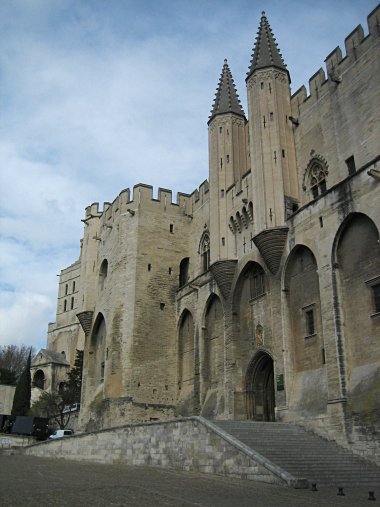
After we finished our pizza, I learned that the primary reason for going to Avignon is the Palais des Papes (palace of the popes, or Pope Castle 1309, as I liked to think of it).
It turns out in the 12th century, things were not to hot in Rome for the pope, so Pope Clement V decided to move the papacy (the center of all Christendom, as my audio tour device liked to call it), to Avignon, from March 9, 1309 till January 13, 1377. Seven popes resided there during that 68 year period. Who knew? So for a few hours Tuesday afternoon (March 20th) we walked around the palace, listening to audio excerpts from room to room.