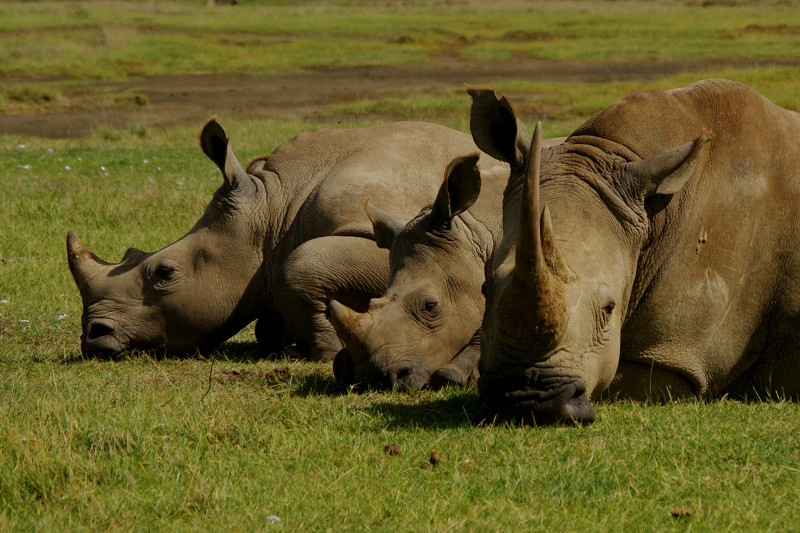
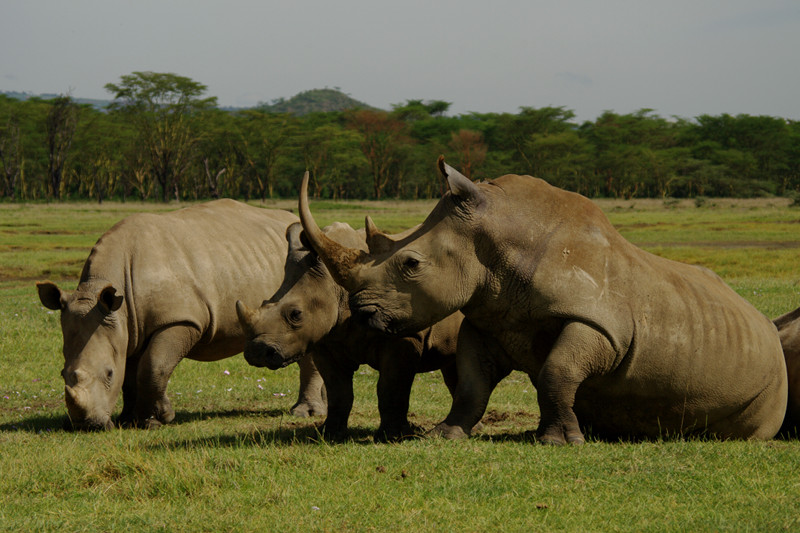
Not far from the flamingos, we stumbled upon a family of white rhinos near the shore of Lake Nakuru—our first rhinoceros sighting on the trip (or ever). They didn’t seem very disturbed by our presence, so we were able to get quite close while they napped. Eventually they resumed grazing and wandered off.
One of the highlights of our safari at Lake Nakuru was getting out of the matatus near the shore to experience a “flamboyance” of flamingos up close—or as close as they’d let us get. Flamingos are strange creatures. Contrary to their iconic one-legged pop culture pose, they spend a lot of time with their heads in the water, scooping up and filtering algae (their food) using special hairy structures (lamellae) built into their unusual bent beaks. Each of us has some prototypical idea of what a “bird” is (e.g. wings, feathers, beak, flies), yet I am amazed at how much variation and adaptation there exists among birds alone, at how specialized something as “basic” as a beak can be.
Flamingos as far as the eye can seeFlamingos in the grassThe “Greater Flamingo” stands out, literally
The first stop on our overland expedition was Lake Nakuru National Park, 160km northwest of Nairobi. According to the standard itinerary we should have stopped earlier, at Lake Naivasha, to visit Hells Gate National Park, but our mountain gorilla trekking permits (the trip’s raison d’être) were issued for the following Monday, so we had to make tracks to Rwanda. Afterwards we’d have a chance to leisurely visit everything we’d passed on the return to Nairobi.
We arrived at the campground near Lake Nakuru in the early afternoon, and began to set up. Everyone chose jobs for the duration of the trip—mine was stove set up, Stephanie’s was table, lights, and garbage set up. We also volunteered to be the first cook group (we’d partnered with Naas, the South African), so the three of us began making a spaghetti bolognese (sauce from scratch) while the rest of the group set up their tents and got situated.
We were up at 4:30 the next morning (May 17th) to help get things ready for breakfast. Due to the early rise it was simple meal: cornflakes with rehydrated milk, yogurt, coffee, and tea. The night before we’d made sandwiches to bring with us for lunch. Then we cleaned things up so we could depart at 6 for the park. The 15 of us were split up among two safari matatus (vans). The sun was just beginning to rise as we drove towards the park.
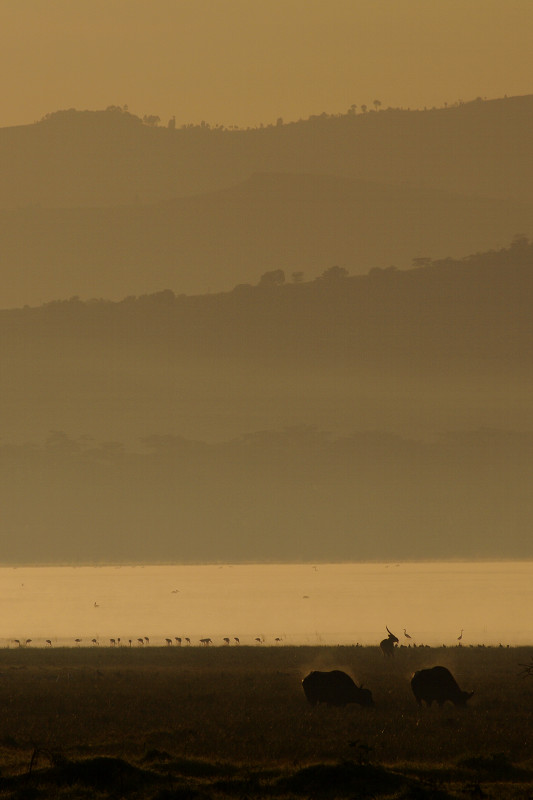
Two steaming buffalo and a waterbuck in the distance
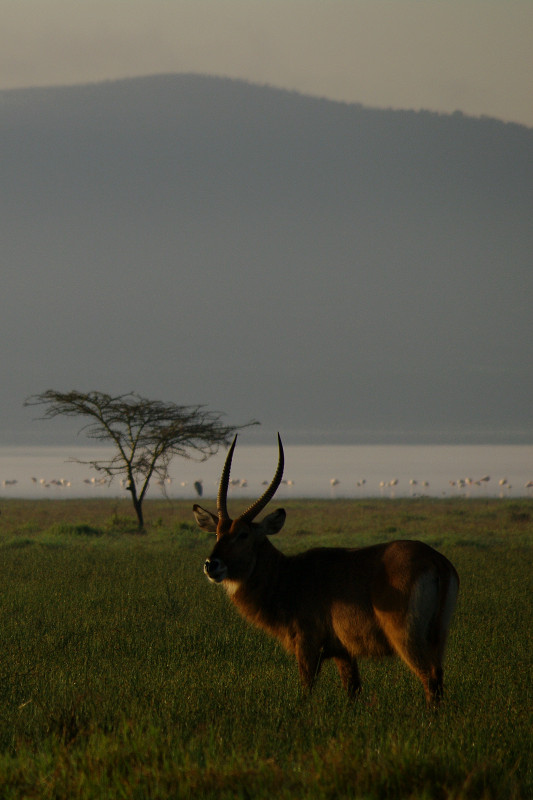
The game drive followed several well-maintained roads around Lake Nakuru. Right off we saw a few waterbucks, many distant birds along the shore, a few zebras, and the occasional buffalo shadowing an egret (or was it vice versa?).
Still, I really love taking wide-angle landscape shots, but it just wasn’t feasible to switch back and forth between the 50-200mm and my workhorse 21mm pancake lens. Lacking the luxury of two camera bodies, I left the telephoto zoom on during the entire safari.
That doesn’t mean I couldn’t or didn’t take any landscape shots. Maasai Mara is sufficiently grand that even at its widest (50mm or 75mm-e) the lens was able to capture some pretty stunning vistas. Here are a few of my favorites.
Savanna grassTopi grazing around an acacia tree at duskPainterly clouds at dawn